Customer research: the complete 2026 guide (methods, examples, and templates)


Customer Research
✓ where to start, and what to ask
Customer research is the systematic process of understanding your customers' needs, behaviors, motivations, and pain points, through interviews, surveys, usability testing, and behavioral analytics. Product and design teams use customer research to reduce product risk, validate decisions before they're built, and find the gaps between what customers say they want and what they actually do.
Customer research is a term that can mean a lot of different things depending on your perspective. We believe customer research is the foundation of a successful organization, especially a product-led organization. The basic premise of customer research is that teams conduct research with their customer base to understand their perspective, pains, successes, and requests. It is through that understanding of customer needs that organizations thrive.
Building a customer research program makes your customers feel heard and valued, leading to long-term partnerships (read: larger CLV). It leads to faster development cycles (nothing says fix me fast like a painful customer interview shared across teams) and more aligned priorities (if most customers have requested this feature, it’s easy to prioritize). Better messaging leads to increased revenue (using words that customers use and describing how you can fix their problem makes it easier to purchase). Those are just a few ways that customer research helps organizations succeed.
In this article, we outline exactly what customer research is, why it's important, who should do it, how it should be done and how to select the right research tools to make it easy. Let’s begin.
Get Brad's research plan template
The one-page plan Brad uses to agree scope, questions, and method before a study starts.
What is customer research?
Customer research is the practice of systematically learning about your customers: who they are, what they need, how they behave, and why they make the decisions they do.
It combines qualitative methods (interviews, usability tests) with quantitative methods (surveys, behavioral analytics) to inform product, design, and go-to-market decisions. Customer research typically answers four types of questions:
- Discovery: What problems do customers have that we haven't solved yet?
- Validation: Does this concept, design, or feature resonate with real users?
- Measurement: How satisfied are customers, and where does the experience break down?
- Behavioral understanding: How do people actually use the product, and where do they get stuck?
The distinction matters because each type calls for different methods, timelines, and participant profiles.
Customer research can take place in the form of focus groups, surveys, or even 1:1 customer calls. For instance, you can decide to set up monthly check-in calls with your SaaS customers and get their feedback on your products and services.
Armed with these insights, you can find ways to improve your product offerings, expand your customer base and remodel your marketing strategy. You may find out that your product messaging is wrong and you need to make adjustments to your marketing segments. User interviews are the foundation of qualitative customer research. See our complete user interviews guide for step-by-step instructions.
Customer research also answers go-to-market questions like these:
- Who are my ideal customers? Which customers will validate my startup achieving product market fit?
- What channels should I use to find and communicate with my customers?
- What price point are customers willing to pay for my product?
Want our 2026 AI Research Toolkit? Download it here, complete with Claude skills, AI prompts, and more.
Customer research vs user research vs market research
These three terms get used interchangeably but mean different things:
Customer research: focuses on your existing customers and prospects: what they need, how they use your product, and why they buy or churn. It's tied to specific product and experience decisions.
User research focuses on the people who use your product, including non-paying users, free-tier users, and even competitors' users. The questions tend to be about behavior and usability.
Market research focuses on the broader market: category trends, competitor positioning, total addressable market, and buyer demographics. It's more strategic than tactical.
In practice, most teams run all three but call them "customer research" as a shorthand. Great Question supports all three through the same platform: interviews, surveys, usability tests, and analysis.
How customer research is changing in 2026
Three shifts are reshaping how teams run customer research:
- AI handles the grunt work. Transcript analysis, theme coding, and pattern recognition now happen in minutes instead of days. This means researchers spend more time designing studies and less time processing data.
- Product teams run their own research. The "people who do research" aren't just researchers anymore. PMs, designers, and engineers are running lightweight studies between sprints, weekly customer interviews, quick concept tests, five-question surveys after a feature launch.
- Research CRMs replace spreadsheets. Teams that used to track participants in Google Sheets now use dedicated research CRMs that handle recruitment, consent, scheduling, and incentives in one place. This cuts recruitment time from weeks to days.
The methods below still apply. What's changed is who's doing them and how fast.
Customer research is not consumer research
There tends to be a misconception that customer research and consumer research are the same things. They’re quite different and shouldn’t be confused. To understand the difference between the two types of research, let’s take a closer look at the difference between a customer and a consumer. A customer is a person or company that buys the product or service. A consumer is a person or company that uses the product or service.
For instance, Microsoft sells Microsoft 365 packages to enterprises and educational bodies that will be used by employees and students. The enterprises and educational bodies are the customers but the employees and students are the consumers.
So while the employees and students are the end-users of the product, they’re not the target customers. The enterprise and educational bodies are. Your marketing efforts need to be directed to the customers and to do that, you need to carry out customer research.
Why is customer research important?
When done correctly, customer research gives you meaningful insights that can lead you to make better business decisions. With well-crafted, thorough research, you’ll be able to understand what your customers really want. You can then iterate your products and services to make sure you’re meeting your customer’s needs. Customer research can help you:
Improve customer experience
When you sit down and talk to your customers, you’ll be able to find out their pain points and (hopefully) fix these pain points. This can lead to a better customer experience. Happy customers stay longer and buy more, and focusing on creating a great customer experience can lead to lower customer churn.
Increase customer satisfaction
Researching customers and talking with your customers allows you to identify specific issues relating to your customers, which you can then fix. This will make your customers feel valued and heard and increase customer satisfaction. Irrespective of how amazing your product is if customers aren’t happy they’re not going to stick around for long. Keep taking the temperature of your existing customers: doing so can increase customer retention and lower customer acquisition costs (CAC).
Build better products
You can’t build products without doing research, your product needs to be aligned with what your customers want. The first thing you should do is conduct customer research to build products that meet the expectations of your customers and then continue carrying out customer research to iterate and build better products. By conducting customer surveys, you can get an idea of the kind of features your customers are hoping for. You can put these feature requests on your product roadmap with the hope to implement this or you might find that there’s a demand for a new product that doesn’t already exist.
When should you do customer research?
Customer research is useful at every stage of the product and customer lifecycle. These are the moments where it changes decisions most often:
- Before you set the roadmap. Discovery interviews and review mining show which problems are worth solving.
- While you design. Concept tests and prototype tests check an idea before engineering time goes into it.
- Before launch. Usability testing catches the tasks people can't complete.
- After launch. Surveys, analytics, and follow-up interviews show whether the change worked.
- When a metric moves. A churn spike or a drop in activation is a prompt to talk to the customers behind the number.
Customer research examples from real teams
ServiceNow: cut average participant recruitment time from 118 days to 6 days after moving to Great Question. 165 researchers now self-serve, engaging 10,000 end users across 300 studies a year.
Brex: grew research participation 10x after removing a bottleneck where only a few people knew how to run studies and recruit participants.
Both teams run research as an ongoing program. The pattern: recruit from your own customer base, run continuous research, store findings in one place, and make them searchable across the org.
Who should do customer research?
Everyone should do customer research. In addition to support and customer success teams who speak to customers as part of their day-to-day jobs, UX researchers, designers, product managers and marketers should all be speaking with customers regularly, with a focus on research topics.
UX researchers
It goes without saying that UX researchers already do a type of research, user experience research. But UX researchers should also carry out customer research. UX research looks at people’s behavior and interaction with a product or service whereas customer research looks at people’s attitudes and reactions to the product or service.
A combination of UX research and customer research will lead to great product development. If customers are leaving or aren’t using the product, a UX researcher can figure out why via customer research and highlight opportunities to fix the product through UX research.
Most companies don't have a dedicated UX researcher. Great Question's UX Research Democratization report (2025 survey) found the ratio of People Who Do Research (PWDR) to dedicated researchers grew from 2:1 in 2020 to 5:1. For every one researcher, there are now five non-researchers running their own customer interviews and surveys.
If you do have a researcher, lean on their expertise and encourage them to carry out customer research alongside their UX work. If you don't, you're in the majority. Customer research has become everyone's job. PMs, designers, customer success, and even engineers are running interviews and surveys alongside (and sometimes instead of) the researchers.
Product managers
Product managers should carry out research to make sure that the product vision is aligned with the customer’s expectations and objectives. Sometimes, product managers rely on confirmation bias to justify product plans. Research removes that bias by giving product managers customer data sets that can be used for product improvement.
Oftentimes, product managers receive product feedback heard from sales development representatives (SDRs) and Customer Success Managers (CSMs) and not the customers themselves. This leads to a few problems:
- Potential miscommunication in feedback communicated. The best way to receive feedback is for the feedback to be communicated by customers directly. This reduces the chance of miscommunication.
- You only hear from the most vocal customers. Some customers might not express their product frustrations yet you are only hearing from the ones that do. So if you introduce product changes based on the feedback, you’re only meeting a small number of customers’ needs. There’s a whole subsection of customers who aren’t being considered.
- Recency bias affects product development. Sales and customer success teams may only remember to communicate the most recent feedback they’ve heard which could lead product managers to release features only targeted at a specific subset of customers.
Research ensures product managers can keep the product development focused on the customer.
Product designers
Customer design research is integral to successful product development. You know how the saying goes, great product design keeps the end user in mind. One of the most important aspects of product design is creating a product your customer will love. How do you find out if your customer loves your product? Research.
Prototype testing is a great way to research how customers feel about your designs. You can get real-time feedback before your product goes to market so you know how the product will perform. You can also research your customer’s usability of your product throughout the whole product development cycle with usability testing.
Marketers
Marketers need to carry out customer research because marketers are often in close contact with customers (directly or indirectly) and as a marketer, you must know how to reach customers. To know how to reach your customers, you need to research your customers.
Typically, marketers carry out market research, but as a marketer, you should also carry out customer research. Both types of research are influenced by each other, market research helps marketers identify the economic trends in the market and whether there’s an economic ability for the target market to pay for the product.
Customer research helps marketers understand what customers are looking for and which marketing strategies to employ. You can do a brand awareness survey to find out whether your brand is resonating with your target audience and if it isn’t, you can adapt your strategy.
Customer research can also help you get ahead of your competitors. If you’re conducting research specific to the audience you’re trying to reach and iterate your products based on the feedback, you’re already one step ahead. Plus, you can also carry out competitor benchmark surveys with competitive evaluation reviews to know exactly what your customers think about your competitors.
Types of customer research
The main types of research fall into four categories: primary, secondary, qualitative and quantitative. But these categories aren’t mutually exclusive, it’s helpful to view these types of research along a 2-dimensional framework with the following axes:
- Primary and secondary on the Y axis
- Qualitative and quantitative on the X axis.
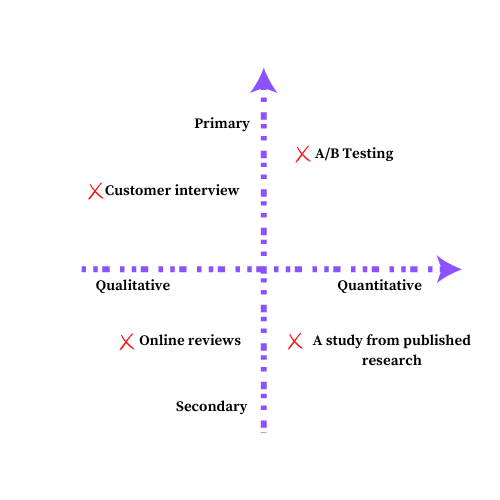
As you can see, primary research can be qualitative or quantitative and secondary research can be qualitative or quantitative.
Primary research vs. secondary research
Primary research is research that is collected directly by you. For example, if you went into the street with a pen and clipboard in hand and asked people what their favorite clothing brand is. That’s primary research.
However, these days most research takes place online, like online surveys rather than stopping customers on the street. Secondary research is research that isn’t collected directly by you.
For example, sifting through online customer reviews or forums to find out how customers feel about a product or service. YELP or Google Reviews are a great example of secondary research. Businesses can view how customers feel about different brands and services.
Quantitative research vs. qualitative research
Quantitative research is all about numbers. It’s the process of collecting and analyzing numerical data. Collecting and analyzing numerical data like average order value (AOV) is an example of quantitive research. Quantitative data is often objective and can be quicker to analyze and present your findings, especially with visual dashboards.
Qualitative research is all about words. It’s the process of collecting and analyzing non-numerical data. Asking customers open-ended questions like “what would you describe the onboarding process like?” is an example of qualitative research. Qualitative data tends to come from smaller sample sizes, like focus groups and in-depth interviews.
Customer research methods
Now that you know the benefits of research, how do you go about gathering it? Here are ten methods to research your customers, followed by a table that maps common product questions to the method that answers them.
Surveys
Surveys are used to gather customer responses to specific questions. For example, a net promoter score (NPS) survey measures customer experience. NPS surveys typically ask respondents if they would recommend your services or product to a friend or colleague.
Customer interviews
Customer interviews are a form of qualitative research that take place between businesses and past, present or future customers about their challenges, goals or feedback on your product. The goal is to use the feedback to iterate on products and services. Customer exit interviews explore why a customer stopped using your product or service.
Prototype testing
Prototype testing involves sharing an early stage prototype or wireframe with your target audience on a device they would use. The purpose is to assess the viability of your product concept. An effective way to do prototype testing is as a video-based study. You can watch your participants use the product live and pair the video recording with product tracking. Watch this webinar to learn more about video-based prototype testing.
Usability testing
Usability testing is used to uncover any potential issues with the product design. There are two types, unmoderated and moderated usability testing. Usability testing involves the participant using the product or service in real-time. For example, a fintech app might ask a group of participants to use the app to see how the payment functions are working.
Related read: The complete guide to UX research methods
Unmoderated testing
In an unmoderated test, participants complete tasks on their own time while their screen and voice are recorded. Nobody runs the session live, so results often come back within a day or two and you can watch where people hesitate, backtrack, or give up. It suits usability checks on live flows, first-click tests, and prototype reviews. You can't ask follow-up questions in the moment, so the task wording has to be clear. See our unmoderated testing guide.
Concept testing
Concept testing shows customers an idea before you build it: a description, a sketch, a landing page, or a rough prototype. You ask whether it solves a problem they have, what they would expect it to do, and how it compares with what they use today. It is quick and cheap, which makes it a good filter for roadmap ideas. Stated interest tends to run high, so watch what people do with the concept as well as what they say. Our concept testing guide covers study design and question sets.
Card sorting
In a card sort, participants group topics or features into categories that make sense to them. In an open sort they name the categories; in a closed sort they use categories you provide. The results show how customers think about your product's structure, which helps with navigation, menus, and information architecture. Pair it with tree testing to check whether people can find things in the structure you settle on. See our card sorting guide.
Diary studies
A diary study asks participants to log their experiences over days or weeks, usually through short prompts on their phone. It catches what a single interview misses: habits, workarounds, and problems that only show up on the third or tenth use. Diary studies take longer to run and need more participant support, so keep entries short and check in regularly to stop people dropping out. Our diary study guide walks through setup and prompts.
Behavioral analytics
Product analytics show what customers actually do: which features they use, where they drop out of a funnel, and how usage changes after a release. Event tracking and session recordings answer what happened and how often, at a scale no interview program can match. They rarely tell you why. Use analytics to find where to look, then follow up with interviews or usability tests with the people who got stuck. Start from a specific question so the dashboards stay useful.
Review mining
Review mining means reading what customers already say about you and your competitors in public: app store reviews, software review sites, Reddit threads, and community forums. It is secondary research, so it costs little and needs no recruiting. Tag reviews by theme to find recurring complaints and the words customers use for their problems, which also helps with messaging. Reviews skew toward very happy and very unhappy customers, so treat them as a source of questions to test. Our guide to customer feedback analysis covers tagging and theming.
Which method answers which question?
Start from the question you need answered, then pick the method. This table covers the questions product teams ask most often.
Question you need answered | Method to start with |
|---|---|
| Why do customers churn? | Method to start withCustomer interviews, including exit interviews |
| Is this feature worth building? | Method to start withConcept testing |
| What percentage of customers want this? | Method to start withSurveys |
| Where do users get stuck? | Method to start withUnmoderated or moderated usability testing |
| Does this prototype flow make sense? | Method to start withPrototype testing |
| How do customers expect our navigation to be organized? | Method to start withCard sorting |
| How does the product fit into a customer's week? | Method to start withDiary studies |
| Where do people drop out of onboarding? | Method to start withBehavioral analytics, then interviews |
| What do customers complain about in our category? | Method to start withReview mining |
Voice of customer research
Voice of Customer is the systematic process of capturing and organizing what customers say about their needs, expectations, experiences, and pain points. It overlaps with customer research, but the two are not quite the same.
Customer research starts with a question you want to answer and uses a research method to investigate it. VoC brings together the feedback customers are already giving you across the business. That feedback might come from NPS and CSAT surveys, support tickets, sales calls, interviews, product feedback, reviews, or conversations with customer success. The challenge usually is not collecting more of it. It is making what you already have searchable and useful.
The old way was to run a survey, write a report, and move on until the next survey cycle. A stronger VoC program continuously brings feedback from different touchpoints into one searchable place, where teams can find patterns across sources instead of analyzing each channel in isolation.
Start with the touchpoints you already have. You do not need another feedback form if customers are already telling support, sales, and research what they need. Bring those sources together, use consistent tags or themes, and connect what you learn back to decisions. Before committing to a roadmap item, for example, look across the repository to see what customers have actually said about the problem you are trying to solve.
Our Voice of Customer guide covers how to run VoC as a program, including the source mix, ownership, cadence, and closing the loop.
How to conduct customer research
Now it’s time to learn how to conduct your research. Here are the five steps for running a single study:
Identify what you want to research
The first step is identifying what you want to research. When you know what you want to research, you’ll know which methods and which types of research you’re going to need. Let’s say you’re a Product Manager at a Health and Wellness brand and you want to launch a new feature. You want to research how your existing customers would feel about this feature addition.
Once you’ve identified what you want to research, you can go ahead and choose your research method.
Choose your research method
Choosing your research method is largely dependent on what type of research you’re doing. So in this case, you want to find out how existing users feel about a potential new feature. This means that you’re looking for primary qualitative research. You’re looking for customers to express themselves with words. However, you still need to choose the exact method.
A survey might not be the best method to use because you’re not exactly looking for answers to a specific set of questions but more of a conversation. A validation interview is a great way to have a conversation with your customers about their thoughts on a potential feature release.
So you know you want to collect primary qualitative research, and you know you want to conduct a validation interview. Now you need to pinpoint how you’re going to do this. Validation interviews can run remotely over Zoom or Google Meet, or in person if you’re visiting customers on site. Remote sessions are usually quicker to schedule across time zones. You’re also targeting existing customers.
Now you’ve got your research method ready, let’s get your research tools ready.
Get your customer research tools ready
You’ve probably heard the famous expression “one is as good as their tools”, well the same applies to research. Your research can only be as good as your tools. You need the right tools to kickstart your research. There are a lot of bases to cover. You need to:
- Build a panel: You’re looking for existing customers. So you probably need to dig into your CRM tool and pull up a list of existing customers.
- Start participant outreach: Once you’ve got your list of existing customers, you need to reach out to see who is interested in participating in your research.
- Schedule interviews: Once you’ve managed to find participants to agree to take part in your research, you need to go ahead and schedule interviews. Sending out individual emails, and messaging back and forth for availability is very time-consuming. Then you need to make sure you’ve added the interviews to your calendar.
- Host your interviews: Zoom or Google Meet? You need to choose where you want your interviews to take place.
- Take interview notes: As the interview is going on, you’ll want to take notes. You can do it the old-fashioned way, by hand or you can use a note-taking app like Notion.
- Offer incentives: You’ll want to send a small token to your participants for their time. This could either be product discounts, a cash gift card or even a charitable donation.
As you can see, there are a lot of tools you need for customer research. The good thing is that it doesn’t have to be this way. You can have one customer research tool that keeps all your research operations in one place.
Make use of Great Question for your customer research. The all-in-one research platform. You don’t have to worry about a lot of tabs open and clicking between different applications. You can build a panel, set your eligibility parameters for your research (targeting a certain demographic) and do your participant outreach with custom landing pages and emails. Speed up your research process by taking advantage of research templates.
If you want to schedule your interviews, you can use the calendar built for researchers. You can schedule group interviews or individual interviews. Interview scheduling comes with Zoom or Google Meet integrated, you choose which one you prefer.
You can also offer incentives immediately after the interviews, all from the platform. So you don’t have to worry about chasing vendors or putting gift card requests to the Finance team.
Using a customer research platform centralizes recruitment, scheduling, and analysis.
Before you scope a full research platform, it helps to know what else is out there. Our roundup of customer feedback tools walks through the 8 platforms most teams compare, so you can spot where your real gap is.
Synthesize your data
Once you’ve conducted the studies and have a bunch of content, synthesizing takes the most time. You need to include the context and insights about the customers and organize findings into themes or topics. Using spreadsheets can get confusing. You want your research to be stored in one place, like a repository. You can review transcripts or survey results. Ideally, you should review customer feedback and start a list of themes or topics that help structure the feedback. Once you have the themes, include specific examples of the topics from customer responses. Having real-world examples from customers can help build compelling insights for your stakeholders.
Share your insights
Keeping good research in a silo should be a crime. There’s nothing worse than an insight being stuck in a repository with no one to hear or read it. As you build themes and include data from customers that back up a theme, include links to docs or slides that include these topics. Use this time to form an opinion on the findings and share it to get their feedback.
Sharing can happen asynchronously or synchronously. Just make sure you leave room for feedback or questions. This dialogue is an important part of determining action items and the subsequent impact of customer research.
Five customer research mistakes that waste everyone's time
- Asking customers what they want. Customers describe solutions, not problems. Ask what they did last time, not what they'd do next time.
- Running one big study per quarter. Continuous research (weekly interviews, rolling surveys) compounds insights. One-off studies decay.
- Researching only when something's broken. The best customer research happens before the roadmap is set, not after the launch fails.
- Ignoring existing data. Support tickets, NPS comments, and sales call recordings are customer research you've already paid for.
- Not closing the loop. If participants never see their feedback reflected in the product, they stop participating. Share what changed because of their input.
How to build a customer research practice
One study answers one question. A practice lets product teams answer new questions every week without starting from scratch. These six steps get you there:
- Build your customer panel. Recruit your own customers into an opt-in research panel, starting from a list in your CRM. 50 to 100 opted-in customers across your main segments is enough to start.
- Set up recruitment infrastructure. If recruiting takes months, teams skip research. Put a panel list, outreach templates, and self-serve scheduling in place so a study can start within days. ServiceNow cut average recruitment time from 118 days to 6.
- Match methods to questions. Start from the decision you need to make, then use the question-to-method table above to pick the method.
- Create a research repository. Store every study, recording, and insight in one searchable repository with consistent tags, so anyone can check what customers already said before starting new research.
- Make it accessible. Give PMs, designers, and engineers templates and guardrails so they can run basic studies without waiting for a researcher. Brex grew research participation 10x after opening research up beyond a few specialists.
- Make it continuous. Put research on a weekly cadence: a concept test while designing, a short survey after a release, a call with a customer who just churned.
Customer research is a continuous journey
Customer research doesn’t stop after the first interview, it’s a continuous process that you should do frequently. Especially if you’re after product-led growth. You’ll want to keep hearing from your customers and improving on your products. One of the best ways to ensure that is to have a customer research platform that will enable you to do so. If you’re ready to get started with your customer journey research, speak to one of us today.
Want our 2026 AI Research Toolkit? Download it here, complete with Claude skills, AI prompts, and more.
Frequently asked questions
What is customer research?
Customer research is the practice of systematically learning about your customers: who they are, what they need, how they behave, and why they make the decisions they do. It uses methods like interviews, surveys, usability testing, and behavioral analytics to reduce product risk and inform product, design, and go-to-market decisions.
What's the difference between customer research, user research, and market research?
Customer research focuses on your existing customers and prospects. User research focuses on anyone using your product, including non-customers. Market research focuses on the broader category and competitive landscape. Most teams run all three but call the combined practice "customer research."
What are the 4 types of customer research?
The four types are primary research (data you collect yourself, such as interviews and surveys), secondary research (data someone else collected, such as online reviews and published studies), qualitative research (words and observations that explain why people act as they do), and quantitative research (numbers that show how many or how often). They combine: a customer interview is primary and qualitative, while analyzing a published industry survey is secondary and quantitative.
How often should teams do customer research?
Many product teams now run continuous customer research, with a short touchpoint every week, such as one interview, a triggered survey, or an unmoderated test on the latest prototype. A few large research sprints per quarter tend to produce insights that are stale by the time they're applied.
How much does customer research cost?
Cost depends on a handful of drivers. Participant incentives rise with session length and how specialized the audience is (our guide to research incentives covers how to set rates). Recruiting your own customers costs little beyond staff time, while external panels charge per participant. Tooling covers recruitment, scheduling, sessions, and storing findings; Great Question paid plans start at $129 per seat per month. Researcher time for planning, running, and analyzing a study is often the largest cost, which is why teams reuse templates and past findings.
What methods are used in customer research?
The most common methods are 1:1 customer interviews, usability testing (moderated and unmoderated), surveys, card sorting, tree testing, concept testing, diary studies, behavioral analytics, and review mining. Most teams use a mix of qualitative methods (interviews, usability) and quantitative (surveys, analytics).
What tools are used for customer research?
Customer research teams typically need tools for participant recruitment, scheduling, incentives, interviewing, unmoderated testing, surveys, transcription, and insight storage. All-in-one platforms like Great Question consolidate these into a single tool.
How do you recruit customers for research?
Three main options: recruit from your existing customer base (via your CRM, email list, or product), use a panel service like Respondent or User Interviews, or use your research platform's built-in panel. Research with your own customers produces better insight because they already know your product.
What's the ROI of customer research?
Customer research reduces the cost of shipping the wrong thing. Teams that run continuous research report faster decision-making, lower development waste, higher conversion rates on launched features, and reduced customer churn. Specific ROI varies but most enterprise research programs track time-to-insight, study throughput, and downstream product metrics.
How do you organize customer research findings?
Through a research repository, a searchable, centralized system where studies, transcripts, and insights are tagged and accessible across teams. Without one, insights stay siloed and past research gets re-run.