
Understand how users think, and keep those insights connected to your central research repository.
Card Sorting is now available in Great Question.
This method helps you uncover how users naturally group, label, and understand your content. Card sorting complements the moderated and unmoderated study types you already use on our platform.
But this launch is about more than adding another method. It's about solving a deeper workflow challenge: keeping research connected.
The problem with standalone card sorting tools
Most card sorting tools handle individual studies well. They let you build a study. Recruit participants. Even analyze results.
But that's where the experience ends.
You still have to:
- Recruit from scratch or manually export/import lists
- Analyze results in a silo, outside your central research system
- Store findings separately from the rest of your work
- Ensure you have the right governance, segmentation, and permissions
- Repeat these steps again and again
This fragmentation slows your team down, duplicates effort, and disconnects insights from the bigger picture.
Card sorting: now fully integrated into your research workflow
With the addition of Card Sorting to Great Question, your team can:
- Recruit directly from your CRM or Respondent's panel of 3M+: No external tools. Just the participants you need, where you already work.
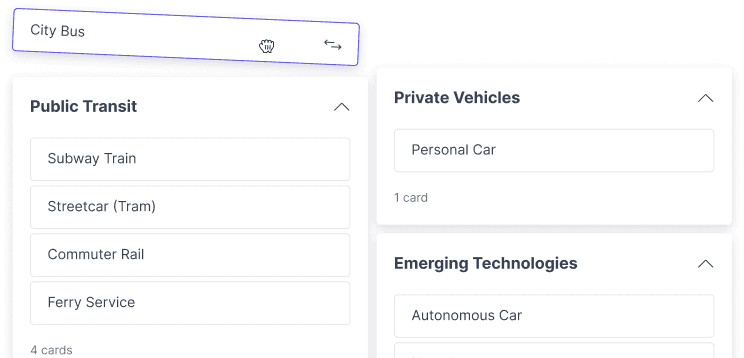
- Run open, closed, or hybrid* card sorts: All study types supported, complete with randomization and drag-and-drop capabilities.
- Analyze results using built-in analysis: Explore grouping patterns, transcripts, and agreement matrices, all automatically linked to your repository.
- Share insights with reels, clips, and summaries: Highlight the "why" behind user behavior in a format stakeholders actually engage with.
- Store everything in one place: No more losing findings. Insights stay connected to projects, themes, and other methods.
- Apply consistent permissions and controls: Keep governance tight across studies with role-based access, data controls, and approval workflows.
*Hybrid card sorting is coming very soon!
Watch our Card Sorting demo below
To load this content, open Cookie preferences, enable Functional cookies, and save your preferences.
Also new: AI summaries you can query
As part of this release, we've also upgraded our Unmoderated AI capabilities.
You can now chat with any response, or the entire study using Great Question AI. Ask follow-up questions, dig into specific patterns, or generate summaries instantly. It works across unmoderated studies, including Card Sorting, and Prototype Testing.
It's research analysis, accelerated, with more AI enhancements coming soon.
Who should use Card Sorting?
UX research teams
- Establish baseline mental models before design exploration
- Standardize studies across teams while maintaining quality and compliance
Product & design teams
- Structure information architectures and navigation menus
- Validate whether your labels make sense to users
- Uncover new groupings and mental models before a redesign
Marketing teams
- Test how users interpret plans, features, and pricing tiers
- Organize content for websites or onboarding flows
🚀 Ready to try it?
Whether you're designing a new IA, testing labels, or planning your next product page, Great Question makes it easy to launch and learn from card sorts. And now, faster to analyze with the assistance of AI.
We built this feature to bring card sorting out of isolation and into your complete research system. So every card sort becomes part of a connected, reusable body of research.