Everybody is a researcher: The democratization of UX research




Editor's note
This article is based on a webinar we conducted with Jane Davis of Zoom.
Understanding the user experience has traditionally been the responsibility of dedicated research teams in large tech organizations. With the amount of digital information available today, organizations with these siloed research teams are limiting the value of their insights.
If other team members are not involved in the gathering of the insights, they often struggle to trust in their value.
This article will help you understand the value in the democratization of research and how to instill that mindset into your teams.
What is research democratization?
Everybody is a researcher under the philosophy of research democratization.
It is an approach to customer research that involves all team members instead of being the domain of strategic operations. This means the flow of information is flat, being exchanged between team members rather than flowing top-down from the operations team.
A team that operates under this philosophy is more collaborative by nature, which allows research insights to be implemented to their full potential.
Download the 2025 State of UX Research Democratization Report
What are the benefits of democratized research?
The flat flow of research information eliminates the politics that comes with hierarchy.
In a traditional organization all research insights flow from the ops team. This can make members of other teams feel defensive, as if they are being told they are doing their jobs wrong, or if something isn't working the way it was intended.
If the ops team doesn't have the communication skills to deliver their insights with tact, then there is a low chance that the information will be put to use.
Democratized research gives all team members a stake because they are the ones actually conducting the research. It helps them understand how the insights fit within the context of their jobs.
Another benefit is that it establishes a culture of team members who take initiative in identifying knowledge gaps and coming up with solutions. This is compared to a traditional system where all strategy is dictated by the ops team.
What is the process for getting organizational buy-in to research initiatives?
Smaller organizations that do not have the benefit of a dedicated ops team are used to a democratic approach towards research.
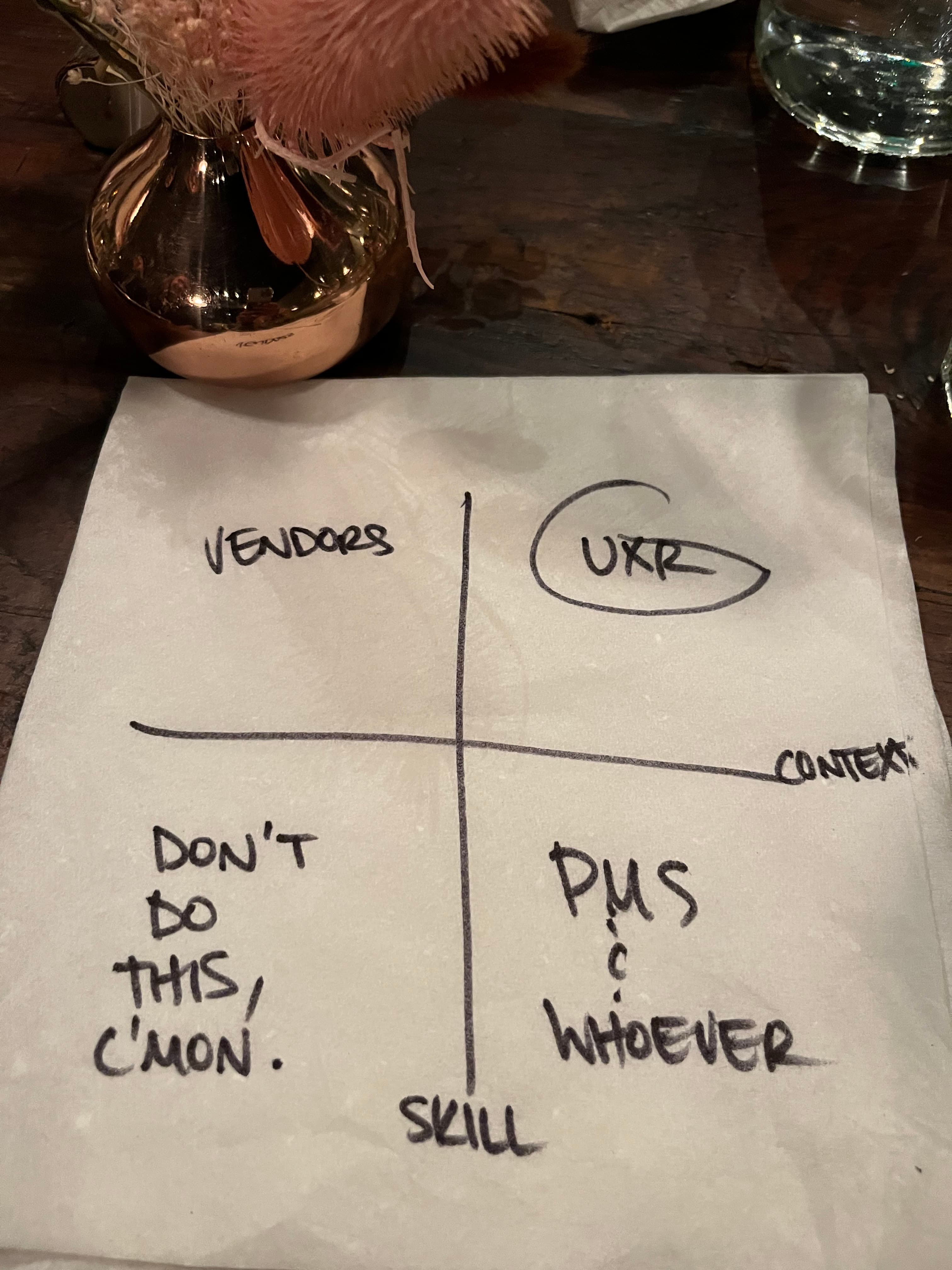
Large organizations, on the other hand, can be entrenched in a siloed approach. Getting decision-makers to buy into a reorganization of their headcount is a big ask. You have to be able to clearly convey the value of such a transition. Jane summed it up perfectly when she said "the goal becomes how do you use organizational familiarity so your researchers have more time doing high-expertise tasks?"
The quote references a 2x2 matrix she uses to sell executives on the value of a democratized research approach. The two dimensions are organizational context and research expertise, producing the following quadrants:
- High level of context, low expertise
- High level of context, high expertise
- Low level of context, low expertise
- Low level of context, high expertise
The goal is to have your research experts spending as much time doing high-context, high-expertise tasks as possible.
To achieve this, you need to build systems for all of the research tasks that fall under high-context, low-expertise. These are the tasks other people within the organization can be trained to do.
How do you build a democratized research team?
If you have a chance to build a research team from scratch, then the single quality every hire must have is initiative. Jane references the Toyota management system when she says "I look for people who don't look for permission to take responsibility."
What she means by that is she wants people who look for the problems to solve and don't wait for permission to try and solve them. She looks for people who can handle trying something out on their own first and then coming to her for tweaks rather than someone who needs direction every step of the way.
Going hand-in-hand with initiative is a natural enthusiasm towards how the organization's customers think. A person who genuinely wants to help the customer can be taught to be a good researcher, but that initial curiosity can't be taught.
Do you want to learn more about democratized research? Check out the recording of the webinar we did with Jane Davis of Zoom.